Identify
Recognize common neuromyths and understand why they remain persuasive.

Continuing Education & Professional Development
Academic Microcredential · OPEN-001
Learn how to recognize misleading claims about the brain and learning, evaluate the evidence behind them, and make better-informed educational decisions.
Stronger judgment, better decisions
Ideas about “learning styles,” using only 10% of the brain, or strict left-brain and right-brain learners still influence educational practice. This microcredential gives you a practical framework for examining these claims and communicating evidence without oversimplifying it.
Recognize common neuromyths and understand why they remain persuasive.
Distinguish scientific evidence from interpretation, opinion, and unsupported claims.
Use critical analysis to support more responsible educational decisions and communication.
Learning outcomes
By the end of the course, you will have a clear method for evaluating claims about the brain, learning, and education.
Course orientation, learning pathway, requirements, and guidance for navigating the microcredential.
Explore how inaccurate ideas about the brain and learning emerge, spread, and persist.
Turn an educational claim into a question that can be examined against evidence.
Analyze nuance, degrees of certainty, and the limits of available evidence.
Distinguish statistical relationships, plausible mechanisms, and evidence of causation.
Apply practical criteria to examine sources, methods, findings, and scientific support.
Work through real-world cases in a practical evidence-analysis lab.
Present conclusions clearly and responsibly while respecting what the evidence can support.
Integrate your learning into an evidence dossier that demonstrates your ability to evaluate an educational claim.
Review completion requirements and the process for receiving your digital certificate and badge.
Course details
Your achievement
After successfully completing the requirements, you will receive a digital certificate and badge documenting the competency you demonstrated.
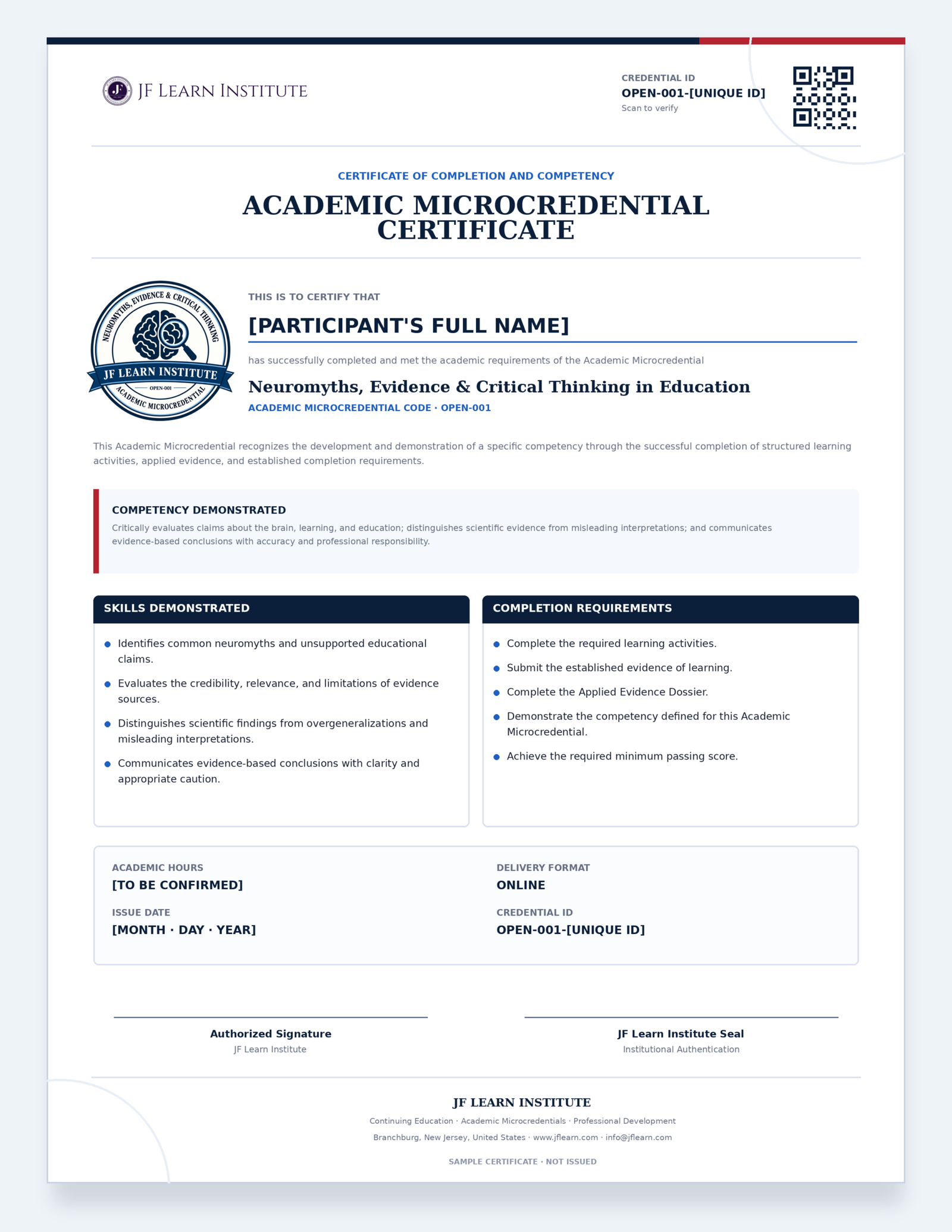
Sample certificate · Select to enlarge
Frequently asked questions
No. Core concepts are explained in clear language and applied progressively to educational situations.
The course is fully online and combines guided content, analysis resources, practical activities, and a final applied evidence dossier.
Complete the required learning activities and successfully submit the final evidence dossier according to the criteria provided in the online campus.
Yes. The digital certificate includes an individual credential code and QR-based verification.
No. This is a non-degree continuing education offering from JF Learn Institute. It does not constitute a degree, academic credit, licensure, or professional certification required by a state authority.
Select “Enroll Now” to open the course in the JF Learn Virtual Campus and follow the enrollment instructions shown there.
Enrollment is open
Enroll in Academic Microcredential OPEN-001 and strengthen your professional judgment when evaluating information about the brain, learning, and education.