Understand
Differentiate major memory systems and the processes of encoding, consolidation, retrieval, interference, and forgetting.

Continuing Education & Professional Development

Academic Microcredential · COG-101
Understand how information is encoded, consolidated, and retrieved—and use contemporary memory science to design more effective learning experiences.
From memory mechanisms to learning design
What learners remember is shaped by how information is encoded, what happens after initial learning, how knowledge is retrieved, and how forgetting and interference interact with practice. COG-101 connects these mechanisms to practical educational design.
Differentiate major memory systems and the processes of encoding, consolidation, retrieval, interference, and forgetting.
Critically examine common simplifications about memory, working-memory limits, training effects, and transfer.
Use retrieval practice, spacing, interleaving, generation, elaboration, feedback, and prior knowledge according to context.
Learning outcomes
By completing COG-101, you will be able to connect core memory mechanisms with concrete decisions in teaching, training, and learning design.
Orientation, learning pathway, expectations, and how Evidence Literacy is integrated throughout COG-101.
Working memory, long-term memory, declarative and nondeclarative memory, and the functional relationships among major memory processes.
Attention, prior knowledge, organization, generation, and elaboration as conditions that influence encoding.
What happens after initial learning, why forgetting occurs, and how competing information can disrupt performance.
Retrieval as an active process, retrieval cues, reconstructive memory, and the educational implications of remembering inaccurately.
Why recalling information and distributing practice over time can strengthen later access to knowledge.
How complementary learning principles can be combined without turning them into universal recipes.
Analyze common memory-related claims, distinguish near from far transfer, and examine what evidence does and does not justify.
Redesign a learning activity using memory principles and justify each design decision with an evidence-based rationale.
Submit a redesigned learning experience with rationale, evidence considerations, and explicit analysis of limitations.
Course profile
Stackable learning
The microcredential is designed as a standalone competency and as a foundation for later study in evidence-based study strategies and self-regulated learning.
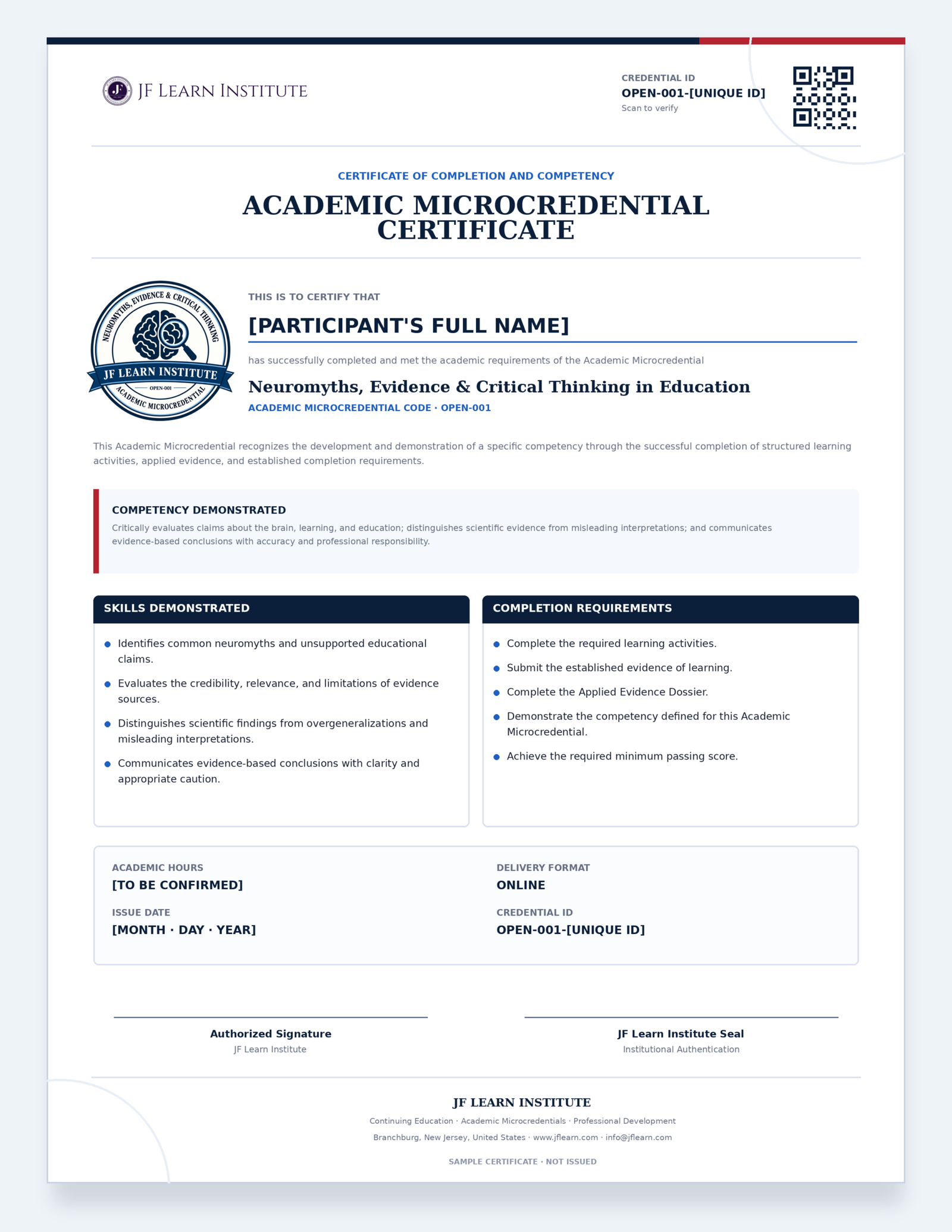
Reference certificate format · OPEN-001 sample shown temporarily while the COG-101 certificate is being produced
Frequently asked questions
No. COG-101 is designed to build the necessary conceptual foundation progressively and connect it directly to educational practice.
No. The microcredential examines memory as a set of cognitive systems and processes and then translates relevant findings into learning design decisions.
You will work with principles such as retrieval practice, spacing, interleaving, generation, elaboration, feedback, and prior knowledge. A later JF Learn microcredential, COG-103, develops study strategies and learning-to-learn competencies in greater depth.
The final applied assessment asks you to redesign a learning experience using memory principles, explain the rationale, and identify relevant limitations.
No. COG-101 is a non-degree continuing-education academic microcredential from JF Learn Institute. Formal hours, credit equivalencies, and any institutional stacking rules are published only when formally confirmed.
The landing page is active while the final delivery and credentialing details are being completed. You may request information to be notified when enrollment opens.
COG-101 · Coming Soon
Request information about Memory Science for Learning and receive enrollment details when the microcredential opens.