Analyze
Examine working memory, inhibitory control, and cognitive flexibility and how they relate to performance in educational tasks.

Academic Microcredential · COG-102
Explore how attention, working memory, inhibitory control, and cognitive flexibility influence learning—and design educational supports that reduce unnecessary executive demands.
From executive demands to educational support
Following instructions, holding information in mind, resisting distraction, shifting between tasks, planning work, and regulating behavior all involve executive demands. COG-102 develops a functional framework for analyzing those demands without turning educational observation into clinical diagnosis.
Examine working memory, inhibitory control, and cognitive flexibility and how they relate to performance in educational tasks.
Recognize when task structure, instructions, organization, or environmental conditions create unnecessary executive load.
Create educational supports that strengthen planning, organization, and self-regulation while preserving learner agency.
Learning outcomes
By completing COG-102, you will be able to analyze executive demands in a learning situation and translate that analysis into practical educational supports.
Orientation, learning pathway, scope of practice, and the Evidence Literacy lens used throughout COG-102.
Executive functions as a set of cognitive-control processes rather than a single ability.
Holding and manipulating task-relevant information, managing multi-step directions, and recognizing when task demands exceed available support.
Response inhibition, interference control, attention to task-relevant information, and the educational implications of distraction.
Shifting perspectives, strategies, rules, and task sets when conditions change.
Analyze how instructions, task complexity, transitions, organization, and environmental structure create executive demands.
Educational supports for goal setting, sequencing, monitoring, organization, and adjustment during learning.
Examine common overstatements, including claims that working-memory training automatically produces broad academic gains.
Conduct a functional analysis of executive demands in an educational case without making a clinical diagnosis.
Analyze executive demands in a case and design a practical support plan for planning, organization, and self-regulation.
Course profile
Stackable learning
COG-102 owns the core executive-functions competencies in the JF Learn architecture. Later applications, including ADHD in Education, use this foundation rather than redefining the construct.
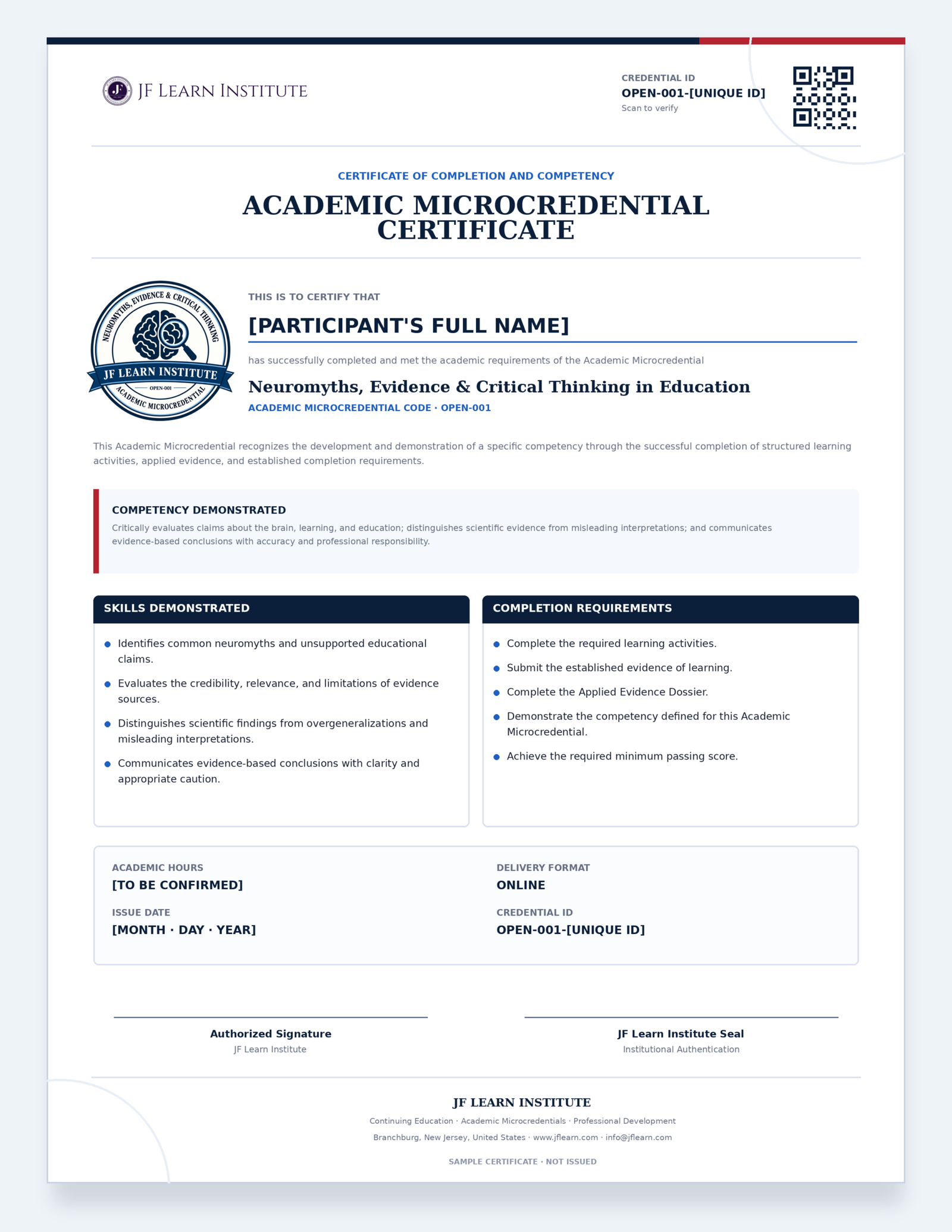
Reference certificate format · OPEN-001 sample shown temporarily while the COG-102 certificate is being produced
Frequently asked questions
No. The microcredential introduces the necessary concepts progressively and keeps the focus on educational application.
No. The course focuses on functional educational analysis, support, observation, and instructional design. It does not train participants to diagnose clinical conditions.
No. Attention and executive control are related but not interchangeable. The course examines their interaction while keeping the core executive-function framework centered on working memory, inhibition, and cognitive flexibility.
The course treats this as an evidence question. Near transfer may occur, but broad far-transfer claims should not be assumed or promised.
The final applied assessment requires a functional analysis of executive demands in an educational case and a support plan focused on planning, organization, and self-regulation.
No. COG-102 is a non-degree continuing-education academic microcredential from JF Learn Institute. Formal hours, credit equivalencies, and institutional stacking rules are published only when formally confirmed.
COG-102 · Coming Soon
Request information about Executive Functions and Learning and receive enrollment details when the microcredential opens.