Select
Choose study strategies according to the learning goal, prior knowledge, task demands, and available evidence.

Academic Microcredential · COG-103
Use retrieval practice, spaced practice, interleaving, self-assessment, and metacognitive monitoring to build more effective and adaptable learning routines.
From knowing strategies to regulating learning
Learners benefit when they can select strategies that fit the task, monitor whether those strategies are working, use feedback, and adjust their plan. COG-103 focuses on applying evidence-based study strategies within a self-regulated learning process.
Choose study strategies according to the learning goal, prior knowledge, task demands, and available evidence.
Use self-assessment, feedback, and metacognitive checks to judge whether learning is actually improving.
Revise study plans when progress is weak and build routines that support more independent learning.
Learning outcomes
By completing COG-103, you will be able to build and justify a self-regulated learning plan for a concrete learning goal.
Orientation, prerequisite knowledge, learning pathway, and the role of Evidence Literacy throughout COG-103.
Planning, monitoring, evaluating, and adjusting learning rather than relying on passive repetition.
Using active recall to strengthen access to knowledge and detect what is not yet learned.
Distributing practice over time and building study schedules that support repeated retrieval.
Mixing problem types or content when it supports discrimination and flexible strategy use.
Comparing confidence with actual performance and using feedback to improve judgments about learning.
Choosing strategies according to what the learner already knows, what the task requires, and the learning goal.
Evaluate common claims about rereading, highlighting, cramming, multitasking, and other widely used study practices.
Build a self-regulated learning plan for a concrete goal using strategy selection, monitoring, feedback, and adjustment.
Submit and justify a self-regulated learning plan, including strategy rationale, monitoring evidence, feedback, and proposed adjustments.
Course profile
Stackable learning
COG-103 uses the memory principles established in COG-101 and applies them to strategy selection, metacognitive monitoring, feedback, and adjustment. It does not reteach memory science from the beginning.
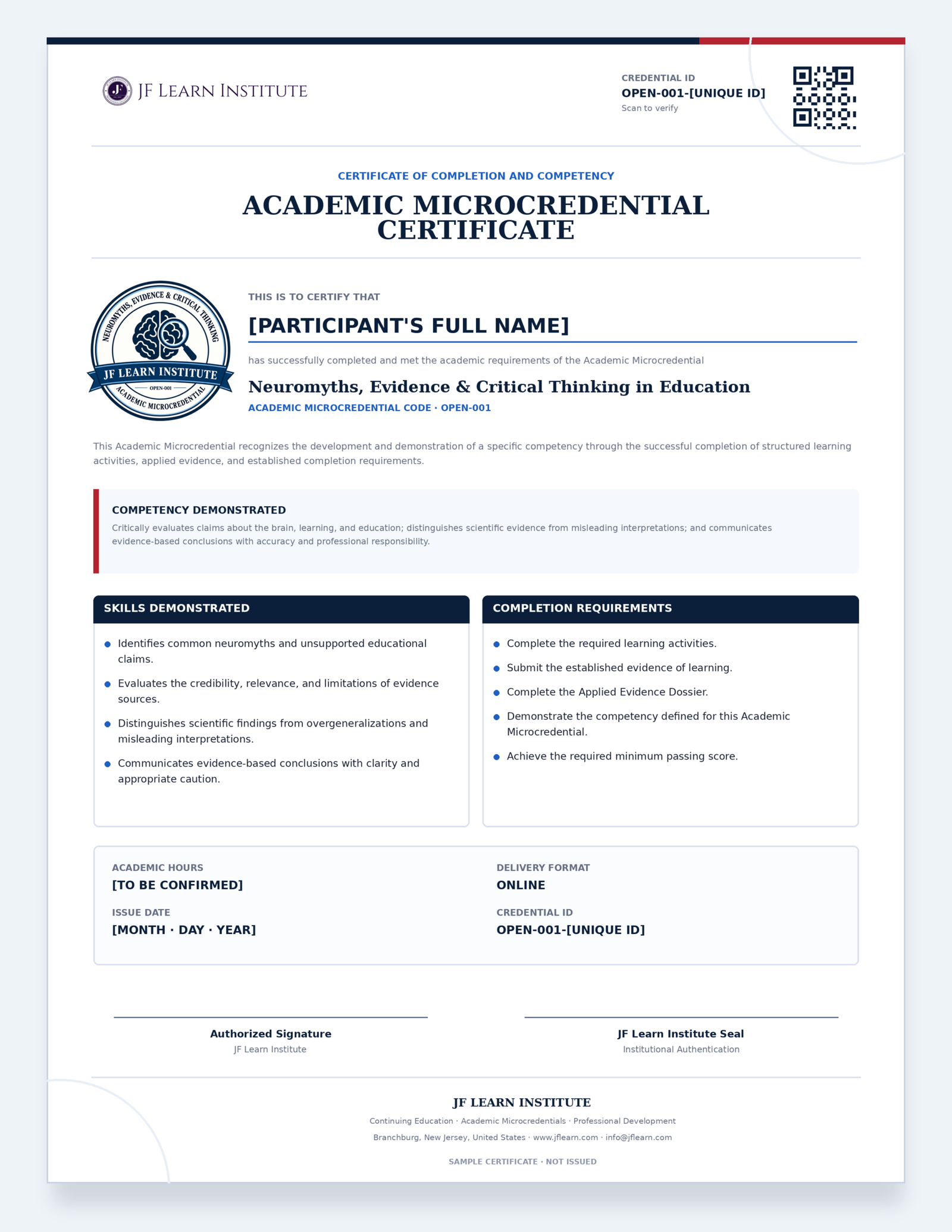
Reference certificate format · OPEN-001 sample shown temporarily while the COG-103 certificate is being produced
Frequently asked questions
Yes. COG-103 assumes the core memory-science foundation developed in COG-101 and focuses on applying those principles to study strategy selection and self-regulated learning.
No. The course is useful for learners, educators, trainers, academic coaches, and professionals who support learning.
No. Strategy effectiveness depends on the task, prior knowledge, learning goal, implementation, and available evidence. The course teaches how to make those decisions rather than prescribe one universal method.
Retrieval practice, spaced practice, interleaving, self-assessment, feedback, and metacognitive monitoring are central, together with deliberate strategy selection and adjustment.
The final applied assessment is a self-regulated learning plan for a concrete goal, including strategy selection, monitoring, feedback, and justified adjustments.
No. COG-103 is a non-degree continuing-education academic microcredential from JF Learn Institute. Formal hours, credit equivalencies, and institutional stacking rules are published only when formally confirmed.
COG-103 · Coming Soon
Request information about Learning How to Learn: Evidence-Based Study Strategies.