Explain
Understand reading as an interaction among cognitive, linguistic, and learned processes.

Continuing Education & Professional Development

Academic Microcredential · LIT-101
Examine how oral language, decoding, comprehension, and cognitive-linguistic processing interact as students learn to read—and evaluate reading claims through an evidence-literate lens.
From language and print to skilled reading
Learning to read depends on interacting cognitive and linguistic mechanisms. LIT-101 builds a foundation for understanding how oral language, print processing, decoding, and comprehension contribute to reading development without reducing literacy to one brain area, one visual skill, or one simplified explanation.
Understand reading as an interaction among cognitive, linguistic, and learned processes.
Relate language and processing mechanisms to the development of decoding and comprehension.
Use Evidence Literacy to examine claims about reading, vision, laterality, and the brain.
Learning outcomes
Orientation, scope, pathway, and the Evidence Literacy lens used throughout LIT-101.
Reading as an acquired cognitive-linguistic achievement rather than a single isolated brain function.
How oral language knowledge contributes to reading development.
Print processing, decoding, and developing efficient access to written words.
How word reading, language comprehension, and knowledge interact during meaning construction.
Reading as a learned network-level achievement, not a function located in one isolated “reading center.”
Reading development across instruction, experience, language, and learner variability.
Evaluate claims and distinguish evidence-supported explanations from oversimplified or unsupported ones.
Integrate cognitive and linguistic mechanisms into a coherent model with educational implications and limits.
Create an explanatory model of reading plus an evidence brief connecting cognitive-linguistic mechanisms with educational implications.
Course profile
Stackable learning
LIT-101 owns the foundational Science of Reading competency in the JF Learn architecture. LIT-102 builds on this base and does not repeat reading foundations.
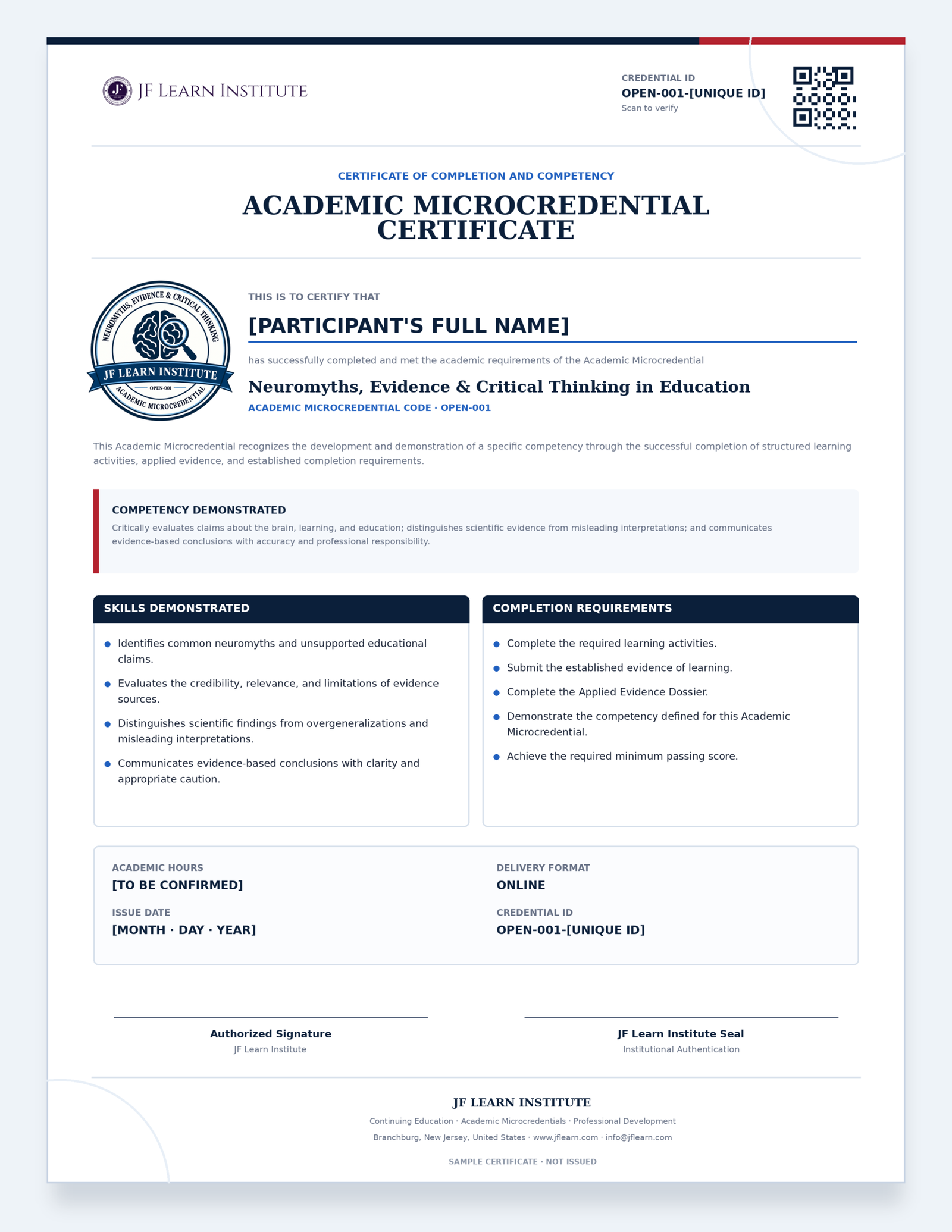
Reference certificate format · OPEN-001 sample shown temporarily while the LIT-101 certificate is being produced
Frequently asked questions
No. LIT-101 is a foundation-level microcredential and introduces the necessary concepts progressively.
No. LIT-101 focuses on reading foundations. Dyslexia is addressed later in LIT-102, which remains educational in scope and does not train participants to make clinical diagnoses.
No. LIT-101 examines reading as a cognitive-linguistic process and uses Evidence Literacy to evaluate claims that reduce reading development to vision or laterality alone.
No. Here the term refers to an evidence-informed body of knowledge about how reading develops, not to one commercial program.
The final assessment combines an explanatory model of reading with an evidence brief connecting cognitive-linguistic mechanisms to educational implications and limits.
No. LIT-101 is a non-degree continuing-education academic microcredential from JF Learn Institute. Formal hours, credit equivalencies, and institutional stacking rules are published only when formally confirmed.
LIT-101 · Coming Soon
Request information about Science of Reading and the Brain.